HCMC doctors, staff protest ICE impact on hospital & patients
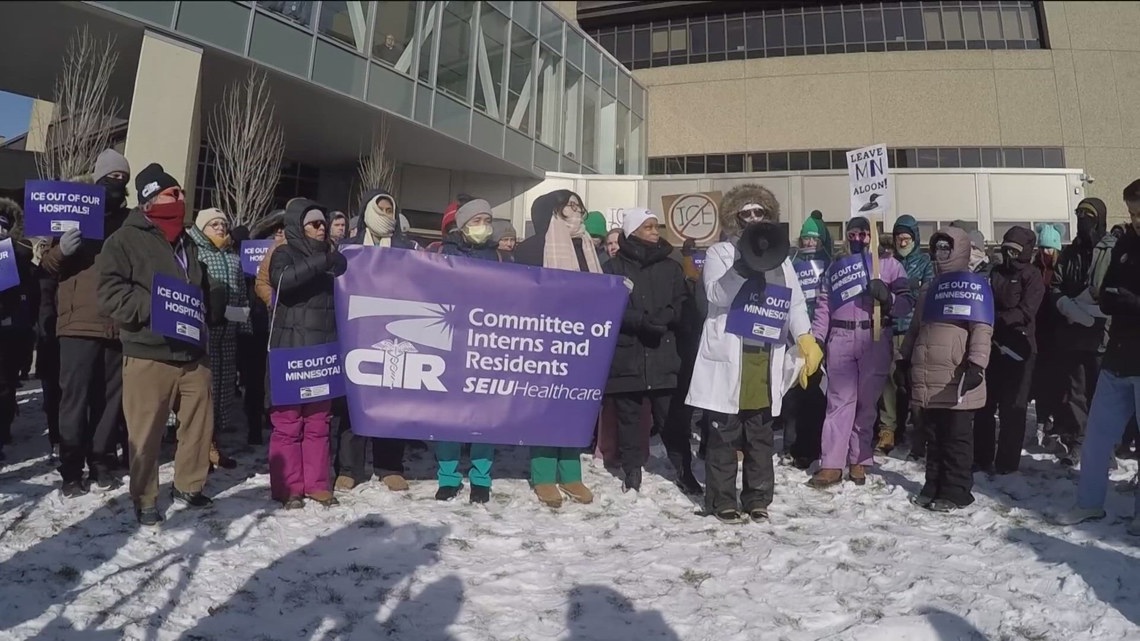
A group of resident physicians and healthcare workers say the presence of ICE agents in and around hospitals and clinics has led to a public health crisis.
MINNEAPOLIS — Dozens of doctors and staff stepped outside of Hennepin County Medical Center on Friday to protest the ongoing ICE operation in Minneapolis.
“Patients are scared to come to the hospital and clinics because of ICE,” said Dr. Zach Perez, a first-year family medicine resident at HCMC. “They are going without medications. Patients with risky pregnancies are going into labor at home alone. It’s not an acceptable situation.”
Perez was among several HCMC and UMN union resident physicians with the Committee of Interns and Residents who led the short protest alongside other essential healthcare workers. He says some patients have avoided care due to fears of encountering agents on the street, he says he’s also troubled by what he’s witnessed inside.
“They are in our hospital right now,” Perez said. “(ICE agents) are interfering with patient care, they are interfering with patients, restraining our patients.”
“One of the ICE agents was saying that he could not be doing any better as he stood guard outside of a patient’s room,” said Dr. Justin Dunnell, an Internal Medicine Resident at HCMC. “Ice officers have been questioning staff about where they are from, commenting on their accent or that they don’t look like they’re around here… so while someone is having the time of their life, my co-workers, my patients are terrified.”
KARE11 reached out to the Department of Homeland Security for a response to the concerns about ICE agents inside the hospital. Assistant Secretary for Public Affairs, Tricia McLaughlin, Assistant Secretary for Public Affairs, responded with the following statement:
“ICE does not conduct enforcement at hospitals—period. We would only go into a hospital if there were an active danger to public safety.
Of course, if we have a detainee we need to take to the hospital for medical care, we have officers accompany them for their monitoring, safety of the staff, and the public. This is standard procedure for all law enforcement agencies.
If we have a detainee we need to take to the hospital for medical care, we have officers accompany them for their monitoring, safety of the staff, and the public.”
The statement did not respond to the specific claims about ICE officers making comments about the race and accents of staff members.
Even staff members who haven’t encountered ICE inside hospitals or clinics say the ongoing operation is disrupting lives and basic routines.
“We’ve been carpooling to and from work because we don’t feel safe,” said Dr. Abishek Thatigutla, a third-year family medicine resident. “A lot of the people who are coming in as international medical graduates can only get into the country about 20 days before they start. They don’t have cars and depend on public transportation and right now, they don’t feel safe doing those things.”
Dr. Thatigutla says he’s also personally grappling with the reality of seeing ICE officers detain someone outside his workplace just two days ago.
“We were watching it from within our clinic and I can tell you that the next day, only three out of 16 patients I was scheduled for showed up,” he said. “That’s not a coincidence.”
“Personally had a patient who had a very serious condition and wanted to leave the hospital – with that serious condition – because they were afraid of what ICE was going to do,” Perez said.
And they fear that chilling effect will remain, as long as the operation continues.
“This is an entirely preventable public health crisis that is caused by ICE,” Perez said.
link